Which of the Following Compounds Can Exist as Optical Isomers
Optical Isomerism in Organic Molecules
- Folio ID
- 3652
Optical isomerism is a course of stereoisomerism. This folio explains what stereoisomers are and how yous recognize the possibility of optical isomers in a molecule.
What are stereoisomers?
Isomers are molecules that have the aforementioned molecular formula, but have a different organization of the atoms in space. That excludes any unlike arrangements which are simply due to the molecule rotating every bit a whole, or rotating about particular bonds. Where the atoms making up the various isomers are joined up in a dissimilar guild, this is known as structural isomerism. Structural isomerism is not a form of stereoisomerism, which involve the atoms of the complex bonded in the same order, merely in different spatial arrangements. Optical isomerism is one form of stereoisomerism; geometric isomers are a second blazon.
Optical isomerism
Optical isomers are named similar this because of their result on plane polarized light. Elementary substances which prove optical isomerism exist as two isomers known as enantiomers.
- A solution of one enantiomer rotates the airplane of polarisation in a clockwise direction. This enantiomer is known equally the (+) form.
- For example, i of the optical isomers (enantiomers) of the amino acid alanine is known as (+)alanine.
- A solution of the other enantiomer rotates the plane of polarisation in an anti-clockwise direction. This enantiomer is known as the (-) form. So the other enantiomer of alanine is known as or (-)alanine.
- If the solutions are equally concentrated the amount of rotation caused past the two isomers is exactly the same - but in opposite directions.
- When optically agile substances are made in the lab, they often occur equally a l/50 mixture of the two enantiomers. This is known as a racemic mixture or racemate. It has no effect on plane polarised calorie-free.
Origin of Optical Isomers
The examples of organic optical isomers incorporate a carbon atom joined to iv different groups. These two models each have the same groups joined to the fundamental carbon atom, but nevertheless manage to be different:
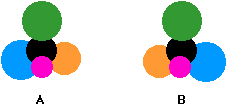
Obviously as they are drawn, the orangish and blue groups are not aligned the same way. Could yous get them to marshal by rotating one of the molecules? The adjacent diagram shows what happens if you rotate molecule B.
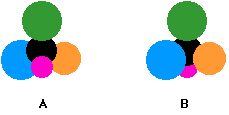
They even so are non the same - and there is no way that you can rotate them then that they wait exactly the same. These are isomers of each other. They are described as being non-superimposable in the sense that (if you lot imagine molecule B being turned into a ghostly version of itself) y'all couldn't slide 1 molecule exactly over the other 1. Something would ever be pointing in the incorrect direction.
What happens if two of the groups attached to the central carbon atom are the same? The next diagram shows this possibility.
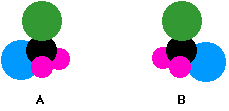
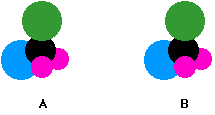
The two models are aligned exactly as before, just the orange grouping has been replaced past another pinkish one. Rotating molecule B this time shows that it is exactly the same equally molecule A. Y'all but get optical isomers if all iv groups attached to the central carbon are different.
Chiral and achiral molecules
The essential difference between the 2 examples nosotros've looked at lies in the symmetry of the molecules. If at that place are 2 groups the same attached to the central carbon atom, the molecule has a aeroplane of symmetry. If you imagine slicing through the molecule, the left-hand side is an exact reflection of the right-paw side.
Where there are four groups attached, there is no symmetry anywhere in the molecule
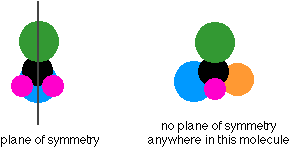
A molecule which has no plane of symmetry is described as chiral. The carbon atom with the four unlike groups attached which causes this lack of symmetry is described as a chiral center or as an asymmetric carbon atom. The molecule on the left above (with a plane of symmetry) is described as achiral. Simply chiral molecules have optical isomers.
The relationship betwixt the enantiomers
I of the enantiomers is simply a non-superimposable mirror paradigm of the other 1. In other words, if ane isomer looked in a mirror, what information technology would see is the other one. The two isomers (the original 1 and its mirror epitome) have a dissimilar spatial arrangement, and and then cannot be superimposed on each other.
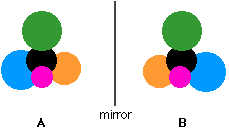
If an achiral molecule (ane with a airplane of symmetry) looked in a mirror, you would e'er detect that by rotating the image in space, you could make the 2 look identical. Information technology would be possible to superimpose the original molecule and its mirror image.
Example one: Isobutanol
The asymmetric carbon atom in a compound (the i with iv different groups attached) is often shown by a star.
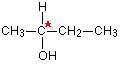
It's extremely important to draw the isomers correctly. Depict i of them using standard bond annotation to prove the three-dimensional arrangement around the asymmetric carbon atom. Then draw the mirror to show the examiner that you know what y'all are doing, and and then the mirror prototype.
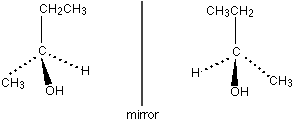
Notice that you don't literally depict the mirror images of all the letters and numbers! It is, however, quite useful to reverse large groups - look, for example, at the ethyl group at the top of the diagram. It doesn't affair in the to the lowest degree in what order you draw the 4 groups around the cardinal carbon. As long as your mirror image is drawn accurately, you will automatically have fatigued the ii isomers.
So which of these two isomers is (+)butan-2-ol and which is (-)butan-two-ol? There is no simple mode of telling that. For A'level purposes, you tin simply ignore that problem - all y'all need to be able to practise is to draw the two isomers correctly.
Example 2: 2-hydroxypropanoic acid (lactic acid)
Once more the chiral center is shown past a star.

The two enantiomers are:
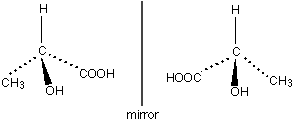
It is important this time to draw the COOH grouping backwards in the mirror image. If y'all don't there is a proficient chance of you joining information technology on to the key carbon wrongly.
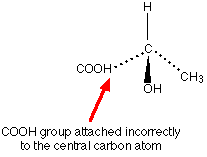
If you draw it similar this in an exam, yous will not become the mark for that isomer even if you have drawn everything else perfectly.
Example 3: 2-aminopropanoic acid (alanine)
This is typical of naturally-occurring amino acids. Structurally, it is just like the terminal case, except that the -OH group is replaced by -NH2

The two enantiomers are:
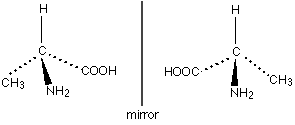
Simply one of these isomers occurs naturally: the (+) grade. You cannot tell just by looking at the structures which this is.
Information technology has, however, been possible to work out which of these structures is which. Naturally occurring alanine is the correct-manus construction, and the way the groups are arranged around the key carbon atom is known as an L- configuration. Observe the use of the capital L. The other configuration is known as D-.
Then you may well find alanine described as Fifty-(+)alanine. That means that information technology has this item construction and rotates the plane of polarization clockwise.
Even if you know that a different compound has an arrangement of groups like to alanine, you however cannot say which mode it will rotate the airplane of polarization. The other amino acids, for example, have the same system of groups equally alanine does (all that changes is the CH3 group), simply some are (+) forms and others are (-) forms.
Information technology's quite mutual for natural systems to only work with one of the enantiomers of an optically active substance. Information technology is not too difficult to see why that might be. Because the molecules have different spatial arrangements of their various groups, merely i of them is probable to fit properly into the agile sites on the enzymes they work with.
In the lab, information technology is quite mutual to produce equal amounts of both forms of a chemical compound when it is synthesized. This happens simply by adventure, and y'all tend to get racemic mixtures.
Identifying Chiral Centers
A skeletal formula is the almost stripped-down formula possible. Look at the structural formula and skeletal formula for butan-2-ol.
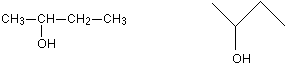
Notice that in the skeletal formula all of the carbon atoms take been left out, too equally all of the hydrogen atoms fastened to carbons. In a skeletal diagram of this sort:
- at that place is a carbon atom at each junction between bonds in a chain and at the terminate of each bond (unless at that place is something else there already - like the -OH group in the example);
- in that location are plenty hydrogen atoms attached to each carbon to brand the total number of bonds on that carbon upwards to 4.
Nosotros accept already discussed the butan-ii-ol case further upwards the page, and you know that it has optical isomers. The second carbon atom (the ane with the -OH attached) has 4 different groups effectually information technology, and and then is a chiral center.
Is this obvious from the skeletal formula? Well, information technology is, provided you recall that each carbon atom has to accept iv bonds going away from it. Since the second carbon here but seems to have 3, there must too be a hydrogen fastened to that carbon. So information technology has a hydrogen, an -OH grouping, and two different hydrocarbon groups (methyl and ethyl).
Four dissimilar groups around a carbon atom means that it is a chiral center.
Example 4: A slightly more complicated case: 2,3-dimethylpentane
The diagrams show an uncluttered skeletal formula, and a repeat of information technology with ii of the carbons labeled.
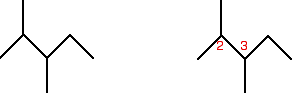
Await first at the carbon atom labeled 2. Is this a chiral middle? No, it is not. Two bonds (i vertical and one to the left) are both attached to methyl groups. In addition, of course, there is a hydrogen atom and the more than complicated hydrocarbon grouping to the right. It doesn't have 4 different groups attached, and then is non a chiral eye.
What about the number 3 carbon atom? This has a methyl group below it, an ethyl group to the right, and a more than complicated hydrocarbon group to the left. Plus, of form, a hydrogen atom to make upward the iv bonds that have to be formed by the carbon. That ways that it is attached to 4 different things, and so is a chiral middle.
Introducing Rings
We will start with a adequately unproblematic band chemical compound:
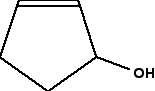
When yous are looking at rings like this, as far as optical isomerism is concerned, y'all don't demand to expect at any carbon in a double bond. You as well don't need to look at whatsoever junction which but has two bonds going abroad from information technology. In that case, there must be 2 hydrogens attached, and then there cannot possibly be iv dissimilar groups attached.
In this example, that means that you only need to look at the carbon with the -OH group attached. It has an -OH grouping, a hydrogen (to brand up the total number of bonds to iv), and links to two carbon atoms. How does the fact that these carbon atoms are part of a ring affect things?
You lot only need to trace back around the ring from both sides of the carbon you are looking at. Is the arrangement in both directions exactly the aforementioned? In this case, it is non. Going in 1 management, y'all come immediately to a carbon with a double bond. In the other direction, yous meet ii singly bonded carbon atoms, then one with a double bond. That ways that you oasis't got two identical hydrocarbon groups attached to the carbon yous are interested in, and and then information technology has four unlike groups in total around it. It is asymmetric - a chiral heart.
What about this near-relative of the last molecule?
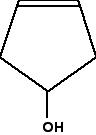
In this instance, everything is equally before, except that if you trace around the ring clockwise and counter-clockwise from the carbon at the bottom of the ring, there is an identical blueprint in both directions. Yous can think of the lesser carbon existence attached to a hydrogen, an -OH group, and two identical hydrocarbon groups. It therefore is non a chiral center.
The other thing which is very noticeable about this molecule is that there is a plane of symmetry through the carbon atom nosotros are interested in. If you chopped information technology in half through this carbon, ane side of the molecule would exist an exact reflection of the other. In the first ring molecule in a higher place, that is not the case.
If you can see a plane of symmetry through the carbon atom information technology will non exist a chiral centre. If at that place is non a plane of symmetry, it will be a chiral center.
Case v: Cholesterol
The skeletal diagram shows the structure of cholesterol. Some of the carbon atoms accept been numbered for discussion purposes below. These are non part of the normal system for numbering the carbon atoms in cholesterol.
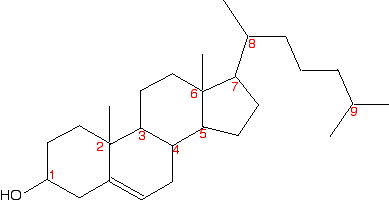
Before you read on, look advisedly at each of the numbered carbon atoms, and determine which of them are chiral centers. The other carbon atoms in the structure cannot be chiral centers, because they are either parts of double bonds, or are joined to either two or three hydrogen atoms.
So . . . how many chiral centers did you find? In fact, there are 8 chiral centers out of the total of 9 carbons marked. If you lot didn't notice all eight, go back and take another await before you read any farther. It might help to sketch the construction on a slice of paper and describe in whatsoever missing hydrogens fastened to the numbered carbons, and write in the methyl groups at the end of the branches besides.
This is done for yous beneath, just it would be a lot ameliorate if you did information technology yourself and so checked your sketch afterwards .
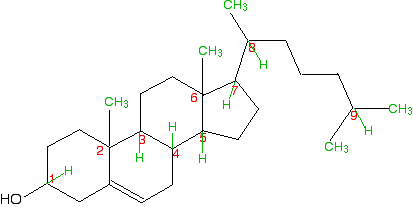
Starting with the easy one - it is obvious that carbon 9 has two methyl groups attached. Information technology doesn't have 4 different groups, and then cannot be chiral. If y'all have a general expect at the residuum, information technology is fairly clear that none of them has a plane of symmetry through the numbered carbons. Therefore they are all probable to be chiral centers. But it's worth checking to meet what is attached to each of them.
- Carbon 1 has a hydrogen, an -OH and two dissimilar hydrocarbon bondage (really bits of rings) fastened. Cheque clockwise and anticlockwise, and you will see that the organisation is not identical in each management. Four different groups ways a chiral center.
- Carbon 2 has a methyl and three other different hydrocarbon groups. If you check forth all three bits of rings , they are all different - some other chiral heart. This is also true of carbon six.
- Carbons three, 4, 5 and vii are all basically the same. Each is attached to a hydrogen and three different $.25 of rings. All of these are chiral centers.
- Finally, carbon eight has a hydrogen, a methyl group, and two different hydrocarbon groups attached. Again, this is a chiral eye.
This all looks difficult at first glance, but it is non. You do, yet, have to take a great deal of care in working through it - it is amazingly easy to miss one out.
finkelsteinalaing1940.blogspot.com
Source: https://chem.libretexts.org/Bookshelves/Organic_Chemistry/Supplemental_Modules_%28Organic_Chemistry%29/Fundamentals/Isomerism_in_Organic_Compounds/Optical_Isomerism_in_Organic_Molecules

Post a Comment for "Which of the Following Compounds Can Exist as Optical Isomers"