The Same Images Are Found Occurring Again and Again

The original 1904 Droste cocoa tin, designed by January Musset (1861–1931)[a]
The Droste effect (Dutch pronunciation: [ˈdrɔstə]), known in art equally an example of mise en abyme, is the effect of a picture show recursively appearing within itself, in a place where a similar motion-picture show would realistically be expected to appear. This produces a loop which mathematically could go on forever, but in exercise only continues as far as the image'due south resolution allows.
The outcome is named after a Dutch brand of cocoa, with an image designed by January Musset in 1904. It has since been used in the packaging of a variety of products. The effect was predictable in medieval works of art such equally Giotto'due south Stefaneschi Triptych of 1320. It is seen in the Dutch artist M. C. Escher'due south 1956 lithograph Impress Gallery, which portrays a gallery that depicts itself. Apart from advertising, the Droste event is displayed in the model village at Bourton-on-the-Water: this contains a model of itself, with two further iterations. The effect has been a motif, besides, for the encompass of many comic books, where it was especially popular in the 1940s.
Result [edit]
Origins [edit]
The mise en abyme effect is named afterwards the image on the tins and boxes of Droste cocoa powder which displayed a nurse carrying a serving tray with a cup of hot chocolate and a box with the aforementioned image, designed past Jan Misset.[2] This familiar image was introduced in 1904 and maintained for decades with slight variations from 1912 by artists including Adolphe Mouron. The poet and columnist Nico Scheepmaker introduced wider usage of the term in the late 1970s.[3]
Mathematics [edit]
The appearance is recursive: the smaller version contains an even smaller version of the picture, and and so on.[four] Merely in theory could this become on forever, every bit fractals do; practically, information technology continues merely equally long as the resolution of the picture allows, which is relatively brusque, since each iteration geometrically reduces the movie's size.[five] [half dozen]
-

Droste effect by image manipulation (using GIMP). Mathematically this could continue forever, but in practice, the recursion is limited by the number of pixels in the image.
Medieval fine art [edit]
The Droste consequence was anticipated past Giotto early in the 14th century, in his Stefaneschi Triptych. The altarpiece portrays in its centre panel Fundamental Giacomo Gaetani Stefaneschi offering the triptych itself to St. Peter.[7] There are also several examples from medieval times of books featuring images containing the book itself or window panels in churches depicting miniature copies of the window panel itself.[eight]
-

The early 14th century Stefaneschi Triptych. In the primal panel is the kneeling figure of Cardinal Stefaneschi ...
-

... who is belongings the triptych itself.
Grand. C. Escher [edit]
The Dutch artist K. C. Escher made utilise of the Droste effect in his 1956 lithograph Print Gallery, which portrays a gallery containing a print which depicts the gallery, each time both reduced and rotated, just with a void at the heart of the image. The work has attracted the attention of mathematicians including Hendrik Lenstra. They devised a method of filling in the artwork's key void in an additional application of the Droste effect past successively rotating and shrinking an image of the artwork.[iv] [nine] [10]
Advertisement [edit]
In the 20th century, the Droste effect was used to market a variety of products. The packaging of Country O'Lakes butter featured a Native American woman holding a bundle of butter with a picture of herself.[4] Morton Table salt similarly made use of the event.[11] The cover of the 1969 vinyl anthology Ummagumma by Pinkish Floyd shows the ring members sitting in various places, with a motion picture on the wall showing the same scene, simply the club of the ring members rotated.[12] The logo of The Laughing Moo-cow cheese spread brand pictures a moo-cow with earrings. On closer inspection, these are seen to be images of the round cheese spread parcel, each bearing the image of the laughing cow.[4] The Droste effect is a theme in Russell Hoban's children'south novel, The Mouse and His Child, actualization in the grade of a label on a can of "Bonzo Dog Food" which depicts itself.[13] [14]
- In advertising
-

Judge comprehend,
19 January 1918
Model village [edit]
A three-dimensional case of the Droste Issue can be seen in Bourton-on-the-Water, England. A model of the village was congenital within the village in the 1930s at a 1:9 scale, using traditional building materials. It contains within it a model of itself, which in turn includes a further smaller model, and then an even smaller model inside that.[fifteen] [16]
- Model of model hamlet, in real village
-
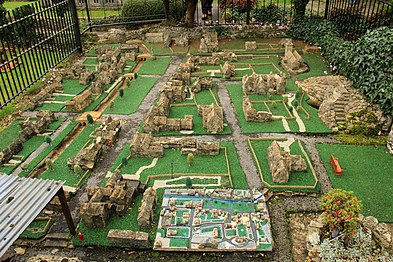
A model replica of Bourton-on-the-H2o village contains a model of the model village, with two more recursions.
Comic books [edit]
The Droste effect has been a motif for the cover of comic books for many years, known every bit an "infinity cover". Such covers were especially popular during the 1940s. Examples include Batman #8 (December 1941-Jan 1942), Action Comics #500 (October 1979), and Bongo Comics Free For All! (2007 ed.). Petty Behemothic Comics #1 (July 1938) is said to be the first-published example of an infinity cover.[17]
Come across also [edit]
- Dream within a dream
- Fractal
- Homunculus argument
- Infinity mirror
- Infinite regress
- Matryoshka doll
- Quine
- Scale invariance
- Cocky-similarity
- Story inside a story § Fractal fiction
- Video feedback
Notes [edit]
- ^ Johannes (Jan) Musset was born in Haarlem on viii March 1861 to Willem Jacobus Musset and Catharina Schmidt, and worked equally a painter of advertisements. He designed the nurse image for Jan Gerard Droste, based on the painting La serveuse chocolat (c. 1745) past Jean-Étienne Liotard.[i] The Droste tin design was reworked only viii years later on by "Cassandre" (Adolphe Mouron) into its more famous form. Musset died in Haarlem on 26 August 1931, and then his design is out of copyright.
References [edit]
- ^ "1863–1918 from confectioner to chocolate producer". Droste. Archived from the original on 4 March 2016. Retrieved 28 Feb 2018.
Around the year 1900 the illustration of the "nurse" appeared on Droste'due south cocoa tins. This is most probably invented by the commercial artist Jan (Johannes) Musset, who had been inspired past a pastel of the Swiss painter Jean Etienne Liotard "La serveuse de chocolat", too known as "La belle chocolatière".
- ^ Törnqvist, Egil. Ibsen: A Doll's Firm, pp.105, Cambridge University Press (1995) ISBN 978-0-521-47866-3
- ^ "Droste, altijd welkom". cultuurarchief.nl. Archived from the original on 30 March 2008. Retrieved eighteen November 2007.
- ^ a b c d Merow, Katharine (2013). "Escher and the Droste Upshot". Mathematical Association of America. Archived from the original on 2 August 2013.
- ^ Nänny, Max; Fischer, Olga (2001). The Motivated Sign: Iconicity in Linguistic communication and Literature. John Benjamins. p. 37. ISBN978-xc-272-2574-0.
- ^ Juola, Patrick; Ramsay, Stephen (2017). Six Septembers: Mathematics for the Humanist. Zea Books. p. 116. ISBN978-i-60962-111-7.
By putting a picture show inside a picture, you get a progression of suggessively smaller, only self-similar images (the box of Droste cocoa has a picture of a woman property a box of Droste cocoa... ). In theory, this nesting could go on forever into infinite particular, only in practical terms, the resolution of the prototype limits how information technology'southward really drawn.
- ^ "Giotto di Bondone and assistants: Stefaneschi triptych". The Vatican. Archived from the original on 30 Nov 2016. Retrieved 23 June 2008.
- ^ Come across the collection of manufactures Whatling, Stuart (16 February 2009). "Medieval 'mise-en-abyme': the object depicted inside itself" (PDF). Courtauld Plant. Archived from the original on 2 November 2013.
{{cite web}}: CS1 maint: unfit URL (link) for examples and opinions on how this effect was used symbolically. - ^ de Smit, B.; Lenstra, H. Due west. (2003). "The Mathematical Structure of Escher'due south Impress Gallery" (PDF). Notices of the American Mathematical Club. 50 (4): 446–451. Archived (PDF) from the original on 16 April 2021. Retrieved 28 April 2021.
- ^ Lenstra, Hendrik; De Smit, Bart. "Applying mathematics to Escher'due south Print Gallery". Leiden University. Archived from the original on 14 January 2018. Retrieved ten Nov 2015.
- ^ Barr, Jason; Mustachio, Camille D. G. (fifteen May 2014). The Language of Doc Who: From Shakespeare to Alien Tongues. Rowman & Littlefield. p. 41. ISBN978-1-4422-3481-9. Archived from the original on x February 2019. Retrieved 17 October 2016.
- ^ Den Hartog, Ben (xi Nov 2011). "The Droste result on Pinkish Floyd anthology Ummagumma". OtherFocus. Archived from the original on 24 November 2015. Retrieved 21 September 2015.
- ^ Kelly, Stuart (31 Dec 2013). "The Mouse and His Child by Russell Hoban: moving metaphysics for kids". The Guardian. Archived from the original on 14 November 2017. Retrieved 13 November 2017.
- ^ "Bonzo Canned Dog Food". Box Vocalization. 20 November 2013. Archived from the original on 14 November 2017. Retrieved xiii November 2017.
- ^ Marshall, Brian Robert (8 May 2013). "Model Village, Model Village, Model Village, The Old New Inn, Bourton-on-The-Water". Geograph. Archived from the original on 11 Dec 2020. Retrieved 17 April 2020.
- ^ Davies, Caroline (19 Apr 2013). "Bourton-on-the-Water model hamlet gets Grade II listed condition". The Guardian. Archived from the original on 8 Dec 2020. Retrieved 17 April 2020.
- ^ Cronin, Brian (xv December 2018). "What Was the First Comic Book 'Infinity Comprehend'?". Comic Book Resource . Retrieved nineteen January 2022.
External links [edit]

- Escher and the Droste issue
- The Math Behind the Droste Effect (article by Jos Leys summarizing the results of the Leiden report and article)
- Droste Effect with Mathematica
- Droste Effect from Wolfram Demonstrations Projection
finkelsteinalaing1940.blogspot.com
Source: https://en.wikipedia.org/wiki/Droste_effect

Post a Comment for "The Same Images Are Found Occurring Again and Again"